


How Community Colleges Use Access Programs to Support Dual Enrollment Success
Driving day-one readiness for high school students earning college credit
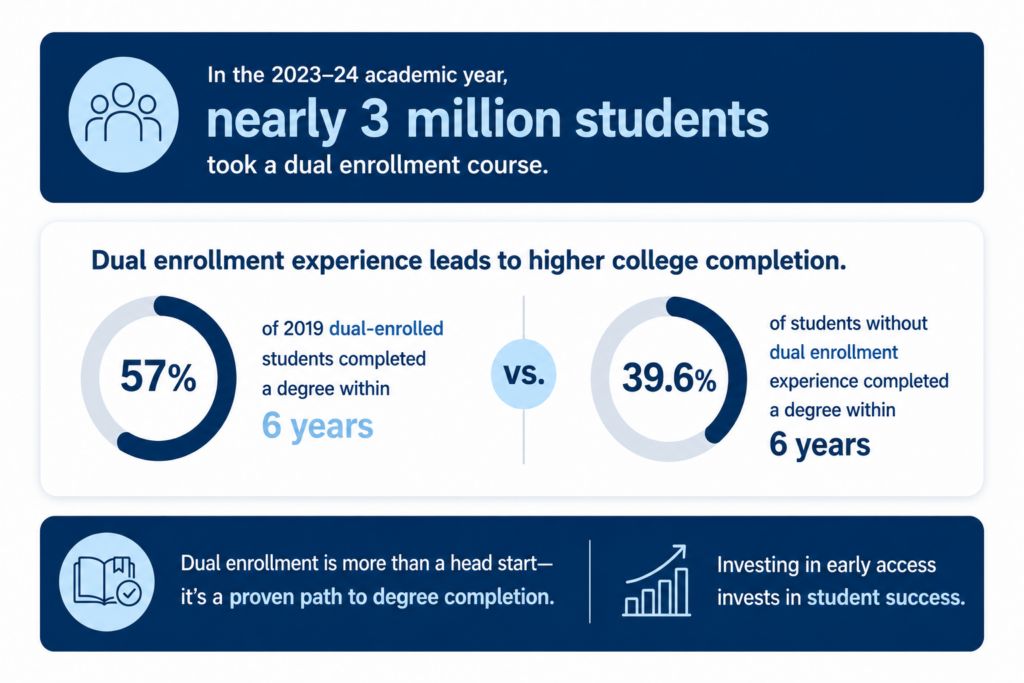
Community colleges are increasingly expanding dual enrollment programs to give students an early start to college: in the 2023-24 academic year, nearly three million students took a dual enrollment course. It’s easy to see why: students with dual enrollment experience are more likely to finish college than those without.
With students able to take dual enrollment courses at little or no additional cost, one barrier to college is removed. However, unexpected course material costs can still create challenges for high school students.
By embedding Course Access programs into a rapidly growing dual enrollment model, campuses are preparing students from day one while improving affordability and expanding opportunity.
Dual Enrollment Growth Requires Scaleable Access Solutions
At many community colleges, dual enrollment has become a central part of strategic goals. Dual enrollment students can make up 25% of the campus’s total enrollment, underscoring the importance of delivering a seamless academic experience for all students.
To support this growth, colleges are offering structured pathways, including:
- Middle College programs, enabling students to earn an associate degree during high school
- Career and technical education pathways, aligned to workforce-ready credentials
Courses are often delivered directly in high schools, with adjunct faculty teaching on-site, removing student barriers related to transportation, time, and cost. As dual enrollment programs expand across a wide geographic footprint, one barrier often remains: how to ensure every student has the course materials they need to succeed.

Delivering Day-One Readiness Through Course Access
What happens when a community college has an existing Access program in place? One Tennessee community college in the Follett network made a critical decision to include dual enrollment students in its Course Access program. This means that high school students received lower-cost course materials seamlessly through their learning management system by day one of class.
To date, 800+ dual enrollment students have been supported, with a participation rate of more than 99%, ensuring near-universal day-one access to learning materials.
By embedding digital course materials directly into the learning management system, students can begin coursework immediately without having to locate and purchase materials on their own. And having Course Access in place makes it significantly more efficient for students, especially those traveling long distances, to get the materials they need, exactly when they need them.
Reducing Costs While Removing Barriers
Affordability remains a key driver of Course Access adoption, and colleges are seeing meaningful results. Student savings created through Access programs help reduce financial strain while maintaining access to required content.
But for dual enrollment students, the value goes beyond cost.
Access removes several critical barriers:
- No travel required to obtain textbooks
- No delays in access, enabling immediate engagement
- No confusion about materials, with everything embedded in the course
Instructors also benefit. With materials available on day one, instructors can focus on teaching rather than troubleshooting access issues, supporting stronger engagement from the start.
A Model for Dual Enrollment Success
By aligning Course Access with a dual enrollment strategy, colleges are removing barriers, improving outcomes, and strengthening the transition from high school to higher education. For students taking their first college course, that support can make all the difference.
Learn more about Follett’s Access Programs to see how your campus can remove barriers to learning, increase student readiness, and create a seamless experience for dual enrollment students.