


How Access Programs Support Retention, Persistence, and Day-One Readiness
Higher education leaders share a common goal: helping students stay on track to completion. But, too often, the student journey begins with friction that can put persistence at risk. Especially for first generation and underserved groups, the process of searching for course materials, comparing prices, waiting on financial aid disbursement, or deciding whether to avoid a required material purchase altogether can put student success at risk.
Forward-thinking institutions are changing that narrative.
Through Course Access and Total Access programs, campuses are simplifying how students receive required materials by embedding course material access directly into the academic experience. The result: greater convenience for students, improved student outcomes, and significant student savings.
A Simpler Start Changes Everything
When students log into class on the first day with their required materials already available, something important happens: they engage.
There’s no scramble to find the right ISBN.
No waiting for shipping.
No guessing whether the purchase can wait.
Access programs ensure course materials are delivered automatically, often through the Learning Management System, on or before the first day of class. The process is simple. The experience is consistent. And the academic impact adds up quickly.
New research underscores just how critical day-one readiness is. According to the 2026 Faculty Watch™ Report from the National Association of College Stores (NACS), nearly all faculty require students to use course materials within the first two weeks of class, with 73% requiring them in the first week alone.
The study also found that 93% of faculty require students to use the book weekly or more often, reinforcing the centrality of course materials to classroom engagement.
Faculty say access programs make a difference in how they teach. The report highlighted:
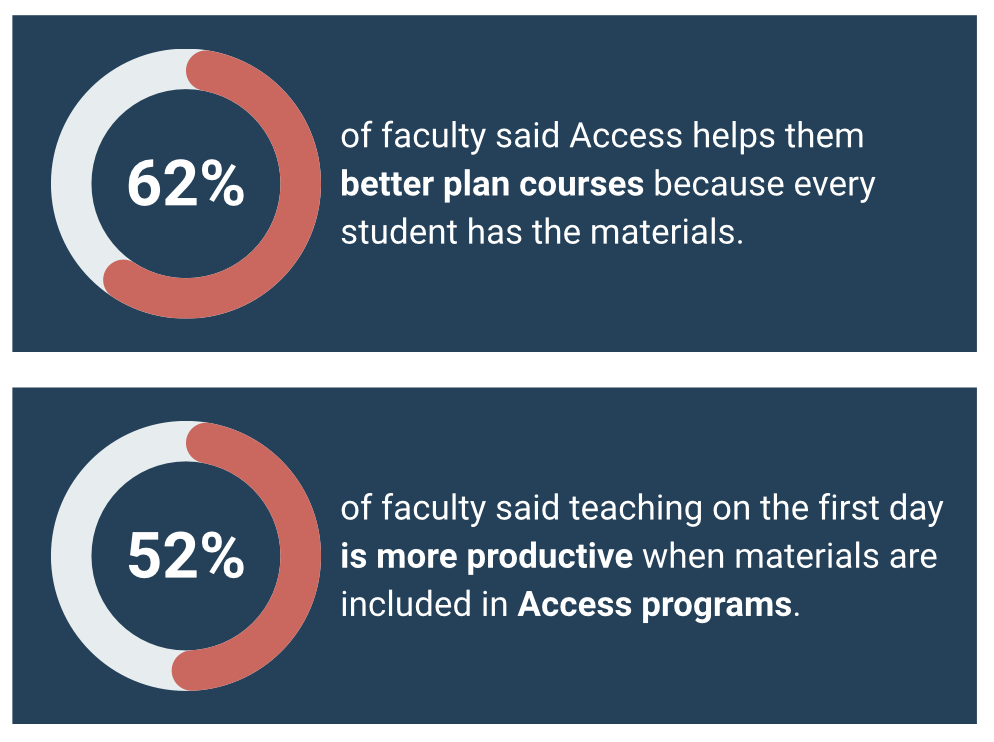
When students start prepared, the entire classroom moves forward together.
Dallas College: A Scaled Model for Simplified Access
Dallas College offers a powerful example of what’s possible when simplified access is implemented at scale. Through its Total Access program, the institution has embedded course material delivery directly into the student experience, ensuring nearly every learner begins the term prepared.
Today, 96% of Dallas College credit students participate in the program, demonstrating how a streamlined, integrated model can drive broad adoption while supporting institutional goals around persistence, retention, and student success.
By removing the traditional barriers associated with acquiring course materials, Dallas College has created a more consistent starting point for students across its campuses and the results are measurable.
- Term-to-term persistence increased from 66% to 70% between 2021 and 2024
- Year-to-year retention rose from 74% to 78% from 2020 to 2023
- Withdrawals from the first day of class through census dropped significantly from 27.1% to 17.9%
- Success rates in the college’s top 30 enrolled courses improved from 69% to 71%
These outcomes illustrate how simplifying access can support broader institutional goals. When students begin the term prepared, they’re better positioned to engage, persist, and succeed.
Reducing Friction, Not Just Costs
Affordability remains part of the equation. Dallas College students save an average of $835 per year, contributing to an estimated $46.7 million in annual savings.
But many institutions are discovering the biggest benefit is something else: simplicity.
When materials are delivered automatically, students don’t have to navigate multiple purchasing options or decide whether they can afford to wait.
Faculty are seeing the value as well. According to the NACS Faculty Watch report, 61% of faculty who have participated in Affordable Access programs report satisfaction with the model, and more than half say they’re interested in participating in additional programs.
The Experience Students Expect

Today’s students are accustomed to seamless digital ecosystems in nearly every aspect of their lives. They expect clarity, simplicity, and transparency. When course materials are integrated into their academic journey, rather than treated as a separate transaction, the experience feels modern and intuitive.
Higher education institutions are under pressure to support more learners, demonstrate measurable outcomes, and remove barriers wherever possible. Simplifying how students access course materials may seem like a small operational change, but as campuses and industry research continue to show, it can make a meaningful difference. Because when students don’t have to worry about how to get their materials, they can focus on why they’re there in the first place.
Ready to explore how Course Access or Total Access could simplify the student experience on your campus?
Learn more about Follett’s Access programs and how we partner with colleges to support student success from day one.